
Xiaodi Hao, Wenbo Yu, Liting Hao and Rabin Liu describe how China is using thermal energy applications in its bid to achieve carbon neutral wastewater treatment.
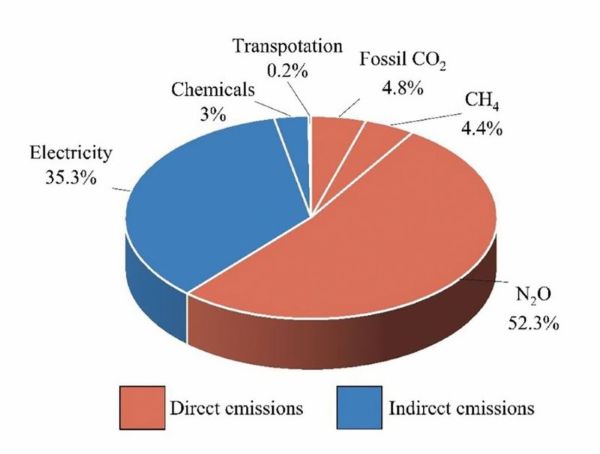
Carbon neutrality is becoming a central theme in China, a key example being China’s Dual Carbon Goals for 2030 and 2060, which have resulted in wastewater treatment plants (WWTPs) moving towards carbon-neutral operations. This is an important step, because greenhouse gas emissions (GHG) from WWTPs are a significant factor in environmental pollution, producing both direct emissions (CH4, N2O and even fossil-based CO2) and indirect emissions (CO2 from fossil-based electricity, chemicals and transportation).
Municipal wastewater treatment typically releases 1.16 kg CO2-eq/m3 of GHG (excluding sludge disposal; Hao and Liu, 2024a). The share of each GHG contributor is shown in Fig. 1, along with direct GHG emissions, which account for 61.5%. Even though indirect GHG emissions may be offset in the future by use of cleaner electricity and ‘green’ chemicals, direct GHG emissions still need to be managed through internal carbon sinks and/or cleaner energy. Among the options available, anaerobic digestion (AD) of sludge is traditionally considered to be a viable alternative. However, the methane (CH4) energy from AD is limited and, even taking combined heat and power (CHP) into account, yields only 15% of the influent organic (COD) energy at best (about 0.20 kWh/m3 in electrical equivalent at CODin=400 mg/L, Hao et al., 2019).
 The second law of thermodynamics demonstrates that the conversion of organics directly into CH4 results in entropy increase. It is best if organics in wastewater are instead converted into low entropy chemical products such as cellulose, biopolymers, volatile fatty acids and polyhydroxyalkanoate (Hao et al., 2024b), as these create opportunities to convert recovered chemicals into energy via incineration (Hao et al., 2020).
If recovered chemicals bring no competitive advantages because of the lack of a market, a process of drying plus incineration of sludge can be used to convert larger amounts of organic energy (an electrical equivalent of up to 32% of the influent COD energy, ~0.50 kWh/m3; Hao et al., 2020). However, even with the help of incineration, the amount of energy required for carbon neutrality often creates difficulties at WWTPs. In the face of this dilemma, the thermal energy contained in wastewater becomes an important consideration.
There is a large amount of heat in wastewater and, after the wastewater has been treated, it makes an ideal water source for thermal conversion (superior to online conversion in sewers because of pretreatment and drops in temperature). It has been determined that a temperature difference of 4 oC extracted from effluent could offer a huge electrical equivalent by water source heat pump (WSHP) of up to 1.77 kWh/m3 for heating and 1.14 kWh/m3 for cooling (Hao et al., 2019). This extracted thermal energy is also a relatively clean form of energy, able to save an emissions equivalent of up to 1.07 kg CO2-eq/m3 for heating and 0.70 kg CO2-eq/m3 for cooling (a conversion coefficient of electricity to CO2: 0.61 kg CO2/kWh; Hao and Liu, 2024a).
Only extracted thermal energy is able to cover direct GHG (0.71 kg CO2-eq/m3), which means it is a critical contributor to the carbon-neutral operation of WWTPs. The thermal energy needs to be directly applied inside and/or outside WWTPs, and implemented through carbon trading mechanisms, something that will lead to thermal utilisation becoming more prevalent in China. Some local governments have issued policies to promote thermal utilisation from wastewater in China, including Beijing, Xi’an, Changchun and Qingdao.
Beijing – a pioneer city in thermal utilisation
Beijing is the capital of China, with an area of 16,410 km2 and a population of about 21.8 million. It is one of the first examples of the implementation of thermal utilisation, with programmes dating back to the year 2000. One iconic project took place in 2008 – a large-scale application of thermal energy for the Olympic Village in the park of the 29th Olympic Games. The building area of the Olympic Village totalled 517,000 m2 (ground area: 410,500 m2; underground area: 106,500 m2), and it was heated (heating load: 21 MW) and cooled (cooling load: 28.2 MW) by WSHP based on the effluent (80,000 m3/d) from a large-scale WWTP at Qinghe (capacity: 550,000 m3/d). The project was able to reduce CO2 emissions by 5,981 t CO2/a.
The second large-scale project to display thermal utilisation is located at a scientific park (Dongsheng II) in the Haidian/Zhongguancun district, a famous high-tech area. The park has four plots (L18, L20, L24 and L25) with a total building area of 550,000 m2. The same effluent, piped 2010 m from the Qinghe WWTP, supplies both heating (53 MW) and cooling (59 MW), with two heat exchange stations (L20 and L24) and nine sets of centrifugal WSHP, associated with three energy pools and numerous water pumps. Through these the project is able to reduce CO2 emissions by 8,022 t CO2/a.
Another large-scale project currently under construction involves concurrent heating for a municipal ring-shaped heat-supply network, where the effluent of 100,000 m3/d from the Gaobeidian WWTP (1 Mm3/d in capacity and the largest in Beijing) is supplied to a nearby thermal power plant, exchanging heat (3.256M GJ/a) from three centrifugal WSHPs (3×10.47 MW). The project will be put into operation at the end of 2025, and is intended to reduce CO2 emissions by 39,300 t CO2/a.
Large-scale applications of thermal energy in Zhengzhou
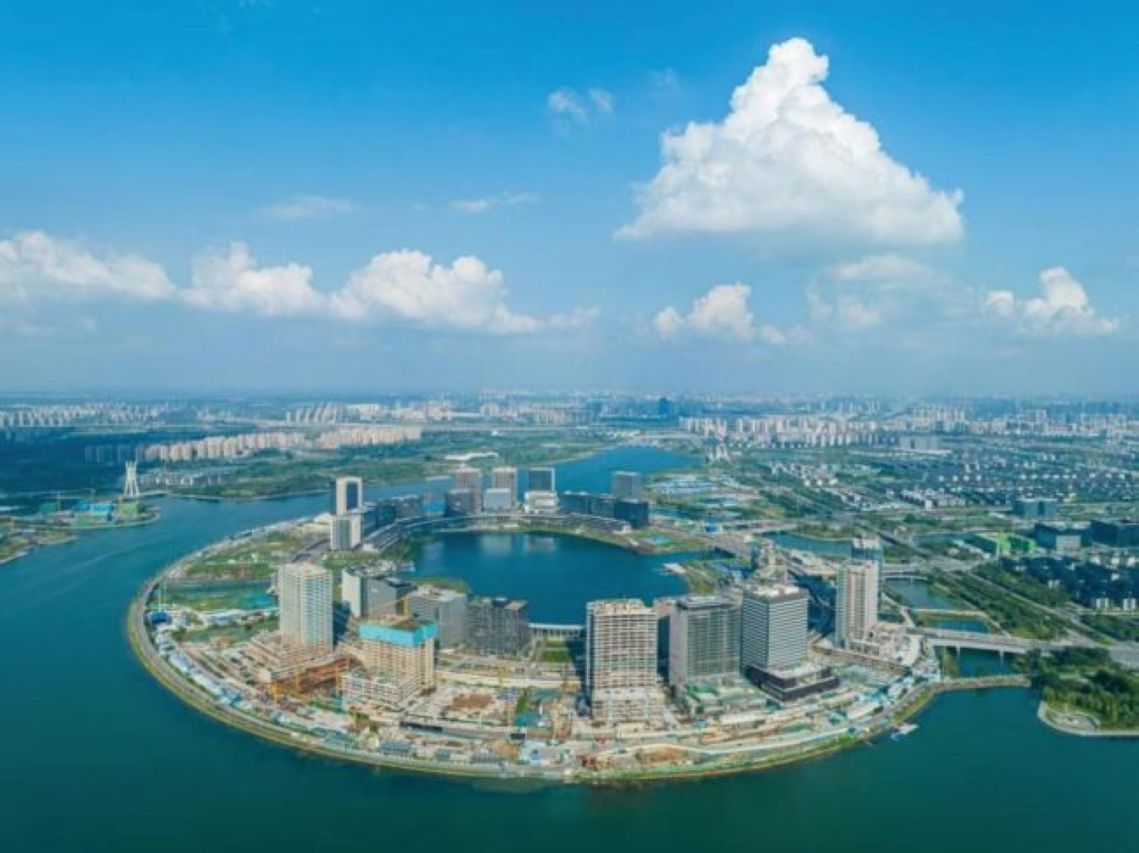
Zhengzhou, a large and centrally located city with an area of 7,567 km2 and a population of about 13 million, is another example of large-scale thermal utilisation based on effluent from local WWTPs (see feature on p34). Underground pipelines for effluent recycling, running beneath the city’s third and fourth ring roads, manage 1.5 Mm3/d of effluent from seven WWTPs. This network provides the opportunity to use thermal energy for the heating and cooling of both domestic and commercial buildings, as well as railway and subway stations. One of the largest projects is ‘Financial Island’, in Dragon Lake, where there are three thermal exchange stations, including 30 WSHPs with a total heating capacity of 57,900 RT. These can use up to 0.6 Mm3/d of effluent and cover a heating/cooling area of up to 3.66 Mm2. Since commencing operations in 2023, the thermal exchange system has operated without any faults, including steadily maintaining room temperatures in all buildings at 22-24 oC, and reducing CO2 emissions by 190,000 t CO2/a.
Taiyuan – a case study in residential heating
Taiyuan, an important centre for coal production 500 km west of Beijing, with an area of 6988 km2 and a population of about 5.5 million, is also taking steps to move towards carbon neutrality. The WWTP (80,000 m3/d in capacity) located in a southern development zone began to use thermal utilisation in the winter of 2024. In cooperation with a local heating company, the plant has opened its effluent for thermal utilisation.
This thermal project was designed to heat neighbourhood residential buildings up to 3.5 km away, with a total heating area of up to 680,000 m2. The thermal exchange station was constructed with four WSHPs and five recirculating pumps, with a temperature difference exchanging 4 oC from the effluent, a water temperature of 47 oC (backwater 41 oC) is supplied via a heating pipeline to the neighbourhood buildings, with a room temperature of 25 oC easily maintained. In winter 2024, an initial area of 150,000 m2 with an effluent capacity of 9,600 m3/d was prepared for thermal heating. The full-scale operation will start in the winter of 2025, resulting in a project that could reduce CO2 by 19,000 t CO2/a.
Xiamen project
A final example highlighting the opportunities with utilisation of thermal energy is a project in Xiamen, Fujian Province. Xiamen is a leisure island city with an area of 158 km2 and a population of 2.07 million, very close to the Jinmen Island of Chinese Taipei. There are no industries apart from some software parks on the island, and three WWTPs (the total capacity up to 900,000 m3/d) are responsible for collecting and treating municipal wastewater. Effluent is normally discharged into the deep sea around the island. Near one WWTP (Qianpu with 400,000 m3/d in capacity), there is a software park, a convention and exhibition centre and a number of hotels within a 3 km radius. This means that there is considerable potential for thermal utilisation from effluent. It is anticipated that Qianpu WWTP could offer 133 MW in cooling energy if 8 oC were exchanged with the coefficient of power (COP) = 6.0 from the effluent, meaning that a total building area of 1.5 Mm2 could be cooled, easily covering the above-mentioned buildings. A programme is being prepared that could result in CO2 emissions of 5,400 t CO2/a (with a cooling period of nine months).
Acknowledgements
The authors thank Beijing BDG Cleaner Energy Investment Co., Zhongyuan Environmental Protection Co., Taiyuan Golden Century Sunlight Co., for Water Purification, and Xiamen Municipal Environmental Technology Co., for their contributions to information, data and figures.
More information
Hao X.-D. and Liu R.-B. (2024a), Guidelines for Carbon Accounting and Emission Reduction in the Urban Water Sector. IWA Publishing, 9781789064223 (eBook), doi.org/10.2166/9781789064223.
Hao X.-D., Li J., Liu R.-B., van Loosdrecht M. C. M. (2024b) Resource Recovery from Wastewater: What, Why and Where? Environmental Science & Technology (Viewpoint), 58, pp14065-14067, doi.org/10.1021/acs.est.4c05903
Hao X.-D., Chen Q., van Loosdrecht M. C. M., Li J., Jiang H. (2020) Sustainable disposal of excess sludge: incineration without anaerobic digestion (Making Waves). Water Research, 170, 115298, pp1-6, doi.org/10.1016/j.watres.2019.115298
Hao X.-D., Li J., van Loosdrecht M. C. M., Jiang H, Liu R.-B. (2019) Energy recovery from wastewater: heat over organics. Water Research (Making Waves), 161, pp74-77, doi.org/10.1016/j.watres.2019.05.106
The authors
Xiaodi Hao, Wenbo Yu, Liting Hao and Rabin Liu are Professor, PhD Student, Lecturer and Associate Professor respectively of Beijing University of Civil Engineering and Architecture, China