

Ashwin Dhanasekar and Prabhushankar Chandrasekeran dive into the AI- and IoT-powered world of next-generation water utilities.
Clean water is crucial for communities and industries, yet it faces significant challenges in the 21st century, with two-thirds of the world estimated to be experiencing water stress, and 1.8 billion people facing absolute scarcity. Climate change worsens this crisis with unpredictable weather affecting water availability and quality. Ageing infrastructure also leads to water loss and inefficiency. In response, the water sector is undergoing a digital transformation using technologies such as artificial intelligence (AI) and the Internet of Things (IoT).
Digitalisation optimises water use, improves efficiency, and promotes sustainability. Industry reports recognise the period we are currently in as a turning point where advanced technologies are showing their potential to address major water issues. This shift marks a move towards innovative solutions to enhance efficiency, resilience, and the long-term sustainability of water resources.
The smart revolution
Addressing the global water crisis requires a comprehensive and integrated strategy. Implementing smarter, resilient and sustainable approaches is necessary to address these issues across urban, rural and industrial sectors. A holistic approach needs to be considered for effectively addressing these challenges. This shift involves moving from reactive problem solving to proactive decision-making that anticipates future challenges and plans for long-term sustainability and resilience. Utilities are increasingly using AI, IoT connectivity and data to transition to a more proactive stance. The future of water management relies on integrating technological solutions into a comprehensive strategy that addresses resource management, infrastructure integrity, environmental protection and service delivery.
Several key enabling technologies are central to this shift. AI is expected to play a significant role in optimising water resources, increasing efficiency, reducing operating costs, and promoting environmental sustainability in the coming years and decades. IoT also provides network infrastructure and sensors for real-time data collection and monitoring, forming crucial input for AI systems. IoT-connected sensors on pumps, valves, meters and within the broader water distribution network, along with Geographic Information Systems (GIS) and Supervisory Control and Data Acquisition (SCADA) systems, create the digital backbone for smart water utilities. Additionally, digital twins – virtual replicas of real-world water systems – are becoming essential tools for improving planning and daily operation through advanced simulations and real-time data integration. These models allow utilities to simulate operational scenarios, predict potential problems, and optimise infrastructure and processes in a virtual environment before making physical changes. These core technologies – AI advancing data analysis and optimisation, IoT to supplement and augment existing data acquisition and connectivity, and digital twins for simulation and planning – are driving the smart water revolution, contributing unique and complementary capabilities toward intelligent and sustainable water management.
Real-time insights
The ability to gain real-time insights into the performance and condition of water infrastructure is changing how utilities operate. Modern data management infrastructure enabled with AI technologies can analyse large volumes of data in real time, leading to improvements in infrastructure management and the optimisation of complex water distribution networks. AI’s ability to process vast datasets instantaneously provides utilities with a better understanding of their systems. Predictive analytics and machine learning (ML) algorithms enable accurate forecasting of water demand across various sectors, allowing for adjustments to supply in anticipation of changing needs. AI continuously learns from historic consumption patterns and live data streams to refine its demand predictions, ensuring that water is available as needed, minimising waste and optimising resource allocation. Additionally, AI can optimise energy consumption within water utilities, particularly in operations, including that of pumping stations. By analysing operational data and demand patterns, AI adjusts pumping schedules and operational parameters to use energy efficiently. Predictive models powered by AI tailor pumping operations to match actual demand, reducing energy waste and operational costs.
Beyond optimising distribution, AI is effective in the early detection and prevention of leaks, fraud and operational irregularities within water utility systems. The deployment of IoT sensors throughout the water infrastructure network allows for continuous monitoring of critical parameters. These sensors can detect shifts in pressure or variations in flow rates that might indicate a leak before it becomes a major problem. This monitoring gives utilities early warning signs, enabling timely intervention. Advanced AI algorithms can analyse historic time-series data, identifying patterns and anomalies associated with past leak events. This allows the system to detect current leaks and predict future leaks in specific areas of the network. A pilot programme in Castle Rock, Colorado, USA, demonstrates AI’s practical application in this domain.
Looking ahead, predictive maintenance is expected to become standard practice in water utilities. Sophisticated algorithms will identify potential equipment failures before they occur by analysing operational data such as vibrations, pressure fluctuations and temperature readings to detect early warning signs. Advanced algorithms will spot these failures proactively using operational data. AI can predict the remaining lifespan of assets such as pumps and valves based on their operational load, environmental conditions and performance data, allowing utilities to schedule maintenance and replacements strategically to minimise downtime and optimise resource allocation. AI models can forecast potential failures in pumps and valves before they happen. The transition from reactive repairs to proactive problem-solving driven by AI-powered predictive maintenance offers benefits including reduced downtime, savings in maintenance costs, and an extension to the lifespan of water infrastructure. (Table 1: Shows key applications of AI and IOT in water utilities)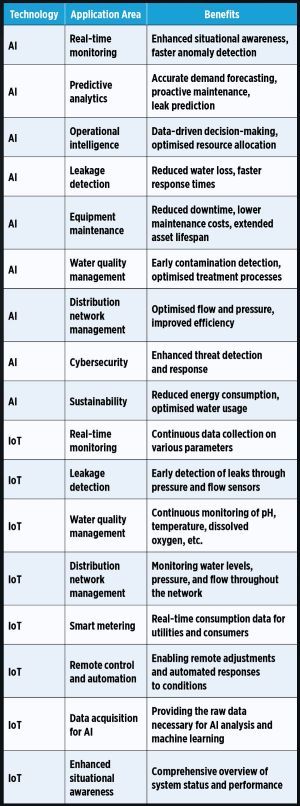
Intelligent operations
Addressing the challenges within the water sector requires a cohesive approach to managing the extensive data produced by contemporary water utilities. Information Technology (IT) and operational technology infrastructure systems are now incorporating advanced AI and operational intelligence systems to tackle these issues efficiently. Modern data management infrastructure offers the capability to securely integrate data sources from within and outside organisational technology boundaries. AI can also potentially function as the central processing unit of these intelligent water utilities.
Using this centralised data, AI offers a comprehensive view of all operational aspects, allowing utility managers and operators to make informed decisions. Operational intelligence, enhanced by AI, is changing water resource management by optimising operations through predictive algorithms, giving organisations a competitive advantage in a challenging environment.
Ultimately, AI enhances decision support capabilities for water utilities, enabling them to anticipate challenges, optimise resource allocation and improve operational efficiency. This leads to a more agile, resilient and effective approach to managing water resources and infrastructure.
The sensor network
IoT is revolutionising next-generation water utilities by creating a connected ecosystem of pumps, valves, meters and other infrastructure. IoT sensors are transforming the water industry, making it more resilient and efficient. Smart water meters enable consumers to monitor their water usage in real-time, fostering awareness and encouraging conservation. They also provide utilities with valuable data on water usage patterns.
In addition to consumption monitoring, IoT sensors enhance water quality management by continuously tracking critical parameters such as pH levels, temperature, dissolved oxygen, turbidity and contaminants. These sensors feed data into AI algorithms that detect trends, identify harmful patterns and predict water quality issues before they escalate. Remote sensing technologies, combined with fluorescence spectroscopy, allow for comprehensive monitoring of larger water bodies, providing early warnings of issues such as nutrient loading and algal blooms.
IoT sensors deployed throughout water distribution networks monitor key operational parameters, such as water levels, pressure fluctuations and flow rates. This data helps utilities optimise operations and detect anomalies indicating leaks or inefficiencies. Integration with digital twin technology creates virtual replicas of water networks, allowing operators to simulate scenarios, predict impacts and optimise infrastructure performance. This detailed monitoring improves efficiency, reduces water loss, and enhances service reliability.
Securing the source
As water utilities adopt digital technologies for enhanced efficiency, they become more vulnerable to cyberattacks and the interconnected nature of smart water infrastructure expands potential attack surfaces. Between 2023 and 2024, cyberattacks on US utility companies surged nearly 70%, driven by motives ranging from financial gain to national-state disruption. These attacks emphasise the geopolitical dimension of this threat.
To counter these threats, strong cybersecurity measures are essential. This includes network segmentation, strong authentication and continuous monitoring. The US Cybersecurity for Rural Water Systems Act aims to bolster defences for smaller utilities lacking resources. And organisations such as WaterISAC provide updated guidance for water and wastewater utilities, covering governance, threat detection, incident response and supply chain security. Effective cybersecurity requires technological safeguards, security policies, employee training and collaboration.
The cyber threats to utilities include ransomware, supply chain vulnerabilities and insider threats. Legacy hardware integration with modern software poses security risks, as does the connection of traditionally isolated operational technology systems to external networks. Addressing these threats necessitates targeted security measures and thorough assessment of third-party vendor security practices.
Sustainable streams
The integration of AI and IoT in water utility operations is enhancing efficiency, reducing costs, and providing environmental benefits. AI-powered leak detection systems and smart irrigation systems are significantly contributing to water conservation by identifying leaks early and optimising water usage based on real-time data. AI-driven demand forecasting further aids efficient water supply management.
Additionally, AI optimises the energy consumption of pumping stations and treatment plants by adjusting schedules based on operational data, leading to energy savings of up to 25% in some cases. Efficient water distribution and leak reduction also reduces the energy needed for water treatment and transportation, highlighting the importance of the water-energy nexus.
The adoption of AI and IoT technologies promotes sustainability in the water sector by enhancing water conservation, energy savings and overall operational efficiency. Integrating these technologies with green infrastructure and advanced purification methods improves water quality sustainably and supports data-driven decision-making for long-term environmental responsibility.
Looking ahead
The integration of AI and IoT in water utility operations is rapidly advancing, with projections showing acceleration beyond this year. The IoT water management market is expected to reach $20.23 billion by 2029 because of global water scarcity, smart city initiatives and government support. Continued research aims to enhance real-time data analytics and manage non-revenue water losses efficiently. Generative AI promises breakthroughs in leak detection, infrastructure optimisation and scenario planning, broadening its impact.
Future smart water management will emphasise resilience against climate change impacts. AI and IoT-enabled Decision Support Systems (DSS) and Early Warning Systems (EWS) are crucial for handling extreme weather events such as floods and droughts. Strategic investments in resilient infrastructure, driven by smart technologies, will improve water storage and distribution capacities. Smart water management will also integrate with broader smart city initiatives, enhancing urban resources and infrastructure efficiency. Intelligent systems for buildings, heating, cooling networks and transportation will coordinate with water management during emergencies, leading to smarter and more sustainable cities. IoT sensors and AI will redefine urban operations, making cities more liveable and eco-friendlier.
Navigating the liquid matrix
We can already see that the integration of AI and IoT is transforming water utilities. This synergy enhances operational efficiency, reduces costs, boosts environmental sustainability, and strengthens water infrastructure resilience. These advancements address major challenges such as water scarcity, outdated infrastructure and climate change impacts. To harness AI and IoT’s full potential for a secure water future, ongoing research, collaboration, and innovation are vital. By leveraging interconnected technologies and data-driven solutions, the water sector can ensure sustainable delivery for future generations.
The authors:
Ashwin Dhanasekar is a principal at Brown & Caldwell (BC) and Operations Lead for BC’s Digital Solutions Group, Denver, USA. He is also a co-founder of an AI/ML based environmental monitoring services company, Ajax Analytics.
Prabhushankar Chandrasekeran is Vice President and national practice leader for Intelligent Water at Arcadis North America, and a member of IWA’s Digital Water Steering Committee.