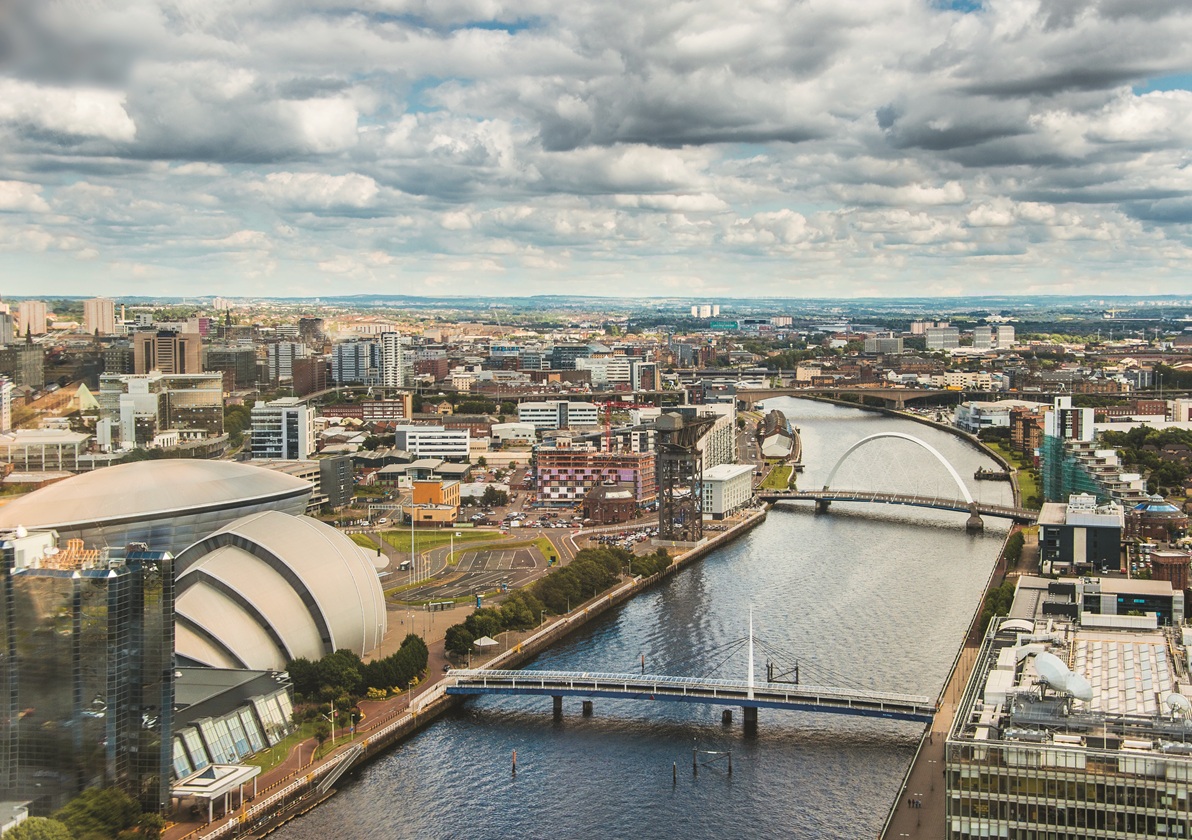
With the 2026 World Water Congress & Exhibition taking place in Glasgow, UK on 4-8 October, Kala Vairavamoorthy celebrates the many valuable dimensions of the event beyond its core technical programme.
As we make the final preparations for our World Water Congress & Exhibition in Glasgow, I have found myself thinking about what it is that makes these gatherings so important to IWA and to the wider water sector.
Perhaps I am biased, but I have often said that the IWA World Water Congress is one of the strongest technical water conferences in the world. For those who fully immerse themselves in the programme, it can feel like a graduate programme on steroids. Over just a few days you can move between the latest science, emerging technologies, utility experience and practical case studies from across the world. Few other events provide such an extraordinary concentration of water knowledge in one place.
But the more I think about Glasgow, the more I believe the real significance of our Congress lies in what happens when we bring all of this knowledge together.
Our members do not simply come to Congress to hear about the latest developments in water; they bring those developments with them. They bring research, operational experience, innovations, successes and failures from utilities, universities, laboratories, regulators, technology companies and communities across the world.
For a few days, all of that experience is brought into one place where it can be shared, challenged and connected. This is important because one of the great strengths of IWA is our ability to connect different worlds: research with practice, innovation with implementation and, increasingly, international ambitions with scientific knowledge and practical delivery.
Our Congress is where much of that connecting takes place.
Created by our members
What gives the Congress its particular character is that it is fundamentally created by our members, for the wider water community.
Our Programme Committee is drawn overwhelmingly from our membership. Our members present the research, organise workshops, lead technical discussions, share operational experience and challenge one another’s assumptions.
Researchers share findings developed over years. Utility professionals explain what happens when good ideas encounter operational reality. Scientists push the boundaries of what we know. Practitioners talk about what worked – and, equally importantly, what did not. Young Water Professionals bring new questions and different perspectives.
Thousands of hours of accumulated knowledge and experience are freely placed into a global commons.
I sometimes wonder whether we sufficiently appreciate how remarkable that is.
A presentation in Glasgow may influence a utility decision thousands of kilometres away. A question from the audience may change the direction of a research programme. A conversation over coffee may connect an innovator with someone capable of implementing their idea.
This is how knowledge travels through our community – and, increasingly, that collective expertise also gives IWA something else: the ability to bring the practitioner and scientific perspectives into discussions about the future direction of the water sector.
From global ambition to practical reality
I was reminded of the importance of this in January, when I attended the Dakar high-level preparatory meeting for the 2026 UN Water Conference, which will take place in Abu Dhabi this December.
I came away encouraged by the ambition and seriousness of the discussions. Water was being understood, rightly, not simply as a sectoral issue, but as fundamental to human rights, public health, climate resilience, economic prosperity and the stability of societies.
Yet, as I listened to the discussions, I found myself returning to a simple question: who will actually have to deliver all of this?
International processes necessarily operate at a political and diplomatic level, where governments negotiate, frameworks are developed and commitments are made. Eventually, however, those commitments have to arrive somewhere very real.
They arrive at a utility. A regulator. A municipality. A treatment plant. Someone has to make them work.
This is where IWA can make an important contribution. Our community includes many of the researchers, utility leaders, operators, regulators, engineers and innovators who, ultimately, have to translate international ambitions into functioning water and sanitation services.
We can therefore do something particularly valuable: stress-test international thinking against science and practice.
A commitment may look compelling in negotiated text but encounter regulatory barriers in practice. A financing model may make sense internationally but fail to reflect how utilities actually operate. A technically elegant solution may struggle because the institutional or professional capacity needed to sustain it does not exist.
Our members understand these realities because they live them.
Glasgow: where ambition meets practice
This connection between policy and practice has been developing through our Congresses for some time.
Copenhagen in 2022 hosted our first dedicated High-Level Summit, bringing ministers and UN agencies into dialogue with our professional community. We deepened that model in Bangkok last December, when the resulting Bangkok Communique captured priorities grounded firmly in the experience of those who actually deliver water services.
Glasgow takes this another step forward. On 5 October, we will convene the Glasgow High-Level Summit on Water for People, deliberately connected to the Water for People dialogue that will form part of the UN Water Conference in Abu Dhabi.
The purpose is not simply to repeat international commitments. We need to understand what it will take to deliver them.
What prevents commitments becoming services? Why do good policies sometimes fail? What institutional and workforce capacity is needed? How should we finance sustainable services rather than simply infrastructure? What do investors sometimes misunderstand about utilities?
These are practical questions, and they are questions our community is exceptionally well qualified to address.
This is what makes holding the Summit alongside the IWA World Water Congress particularly valuable. It creates an opportunity to bring international policy discussions into direct contact with the experience of scientists, engineers, operators, utility professionals, regulators and innovators from across the world. The magic happens when we can bring all of these actors into the same conversation.
What emerges from Glasgow will help inform the voice IWA carries into Abu Dhabi in December, bringing practitioner insight on implementation, financing and institutional capacity into the international discussion.
Few organisations occupy this space between such a deep technical community and the international processes shaping the global water agenda.
We connect international ambition with scientific credibility and practitioner reality. And our ability to do that comes from the depth of expertise our members bring.
A global Congress with strong local roots
Of course, a World Water Congress also depends enormously on the community that welcomes us.
For Glasgow, our Local Organising Committee, built around the IWA UK Committee and with strong involvement from our Young Water Professionals, has helped mobilise the water community in the United Kingdom and bring together organisations and professionals from across the sector.
There has been a tremendous amount of work behind this. Glasgow has been many years in the making, and what has impressed me is the ambition not simply to host an international Congress, but also to create something that genuinely engages the host community.
That contribution can be seen throughout the Congress. The programme has been shaped to connect technical knowledge with some of the larger questions facing our sector, with themes around resilience, One Health, and working with nature. Technical tours will allow delegates to see UK experience in practice, while the forums and other activities create further opportunities for exchange.
Our UK Young Water Professionals are also playing an important part. This matters to me because a Congress should not only showcase the knowledge and experience that already exists in our sector; it should create space for the people who will shape what comes next.
The exchange works in both directions. The UK water community can share its experience while, for a few days, an extraordinary concentration of international knowledge and ideas comes to Glasgow. Those encounters create opportunities to compare approaches, learn from one another and build relationships that last well beyond Congress.
Hosting is also about hospitality. People will remember the papers they heard and technologies they saw, but they will also remember how Glasgow made them feel. Our UK colleagues have worked enormously hard to ensure that people arriving from around the world encounter a community that is open, energetic and welcoming. I am deeply appreciative of everyone who has contributed to making this possible.
A successful World Water Congress should feel unmistakably global, while being firmly rooted in the place that hosts it. I believe Glasgow will do exactly that.
The people beyond the programme
Then there is what happens outside the formal programme. Anyone who has attended an IWA Congress knows the family spirit I mean. Friendships within this Association stretch across decades and continents. Researchers meet practitioners implementing their ideas. Young professionals encounter people whose work they have studied. Colleagues become collaborators, and collaborators become friends.
Some of the most important conversations in Glasgow will never appear in the programme. They will happen over coffee, in corridors, around exhibition stands and late into the evening. Those relationships matter. No one person or organisation has all the answers, and professional trust allows us to share not only our successes but also our failures and uncertainties.
Congress is also an opportunity to recognise the people who make our Association and our sector stronger. Through our awards and honours we celebrate scientific and professional achievement, leadership, innovation, inclusion and service.
I attach great importance to these moments because IWA works through the contribution of its members.
Some of what we celebrate is service to the Association itself: the people who have led a Specialist Group for a decade, reviewed paper after paper, mentored younger colleagues, or quietly given their time and expertise year after year. Some of this contributes to the sector this Association exists to serve: a career that has changed the way we think or work, a young professional already helping to shape what comes next, or someone who has turned equitable access from an aspiration into measurable change.
These contributions take many different forms, but together they make IWA what it is. Congress gives us the opportunity to recognise them and to say, publicly, that they matter.
Where the future is on display
Added to all of this, our exhibition is where you can see, stand by stand, where the water sector is heading. I often describe it as a scientific Congress with an exhibition attached, rather than an exhibition with a conference bolted on. That distinction matters.
Our exhibitors tell us that the people visiting their stands bring an unusually strong scientific and technical understanding. So, the conversation is not simply about what a technology does. It is about why it works, what the evidence shows, where its limitations lie and what the next generation might look like.
The exhibition is therefore not simply about showcasing what is available today. It is also a place where the future is put on display.
Our global community in one place
So, as Glasgow approaches, I look forward to all of this coming together: the extraordinary technical programme, the exhibition, the unexpected conversations, the opportunity to celebrate our members, the welcome from our UK hosts, and a High-Level Summit that will bring the experience of our community into a much wider international discussion. Taken individually, each of these is important. Brought together, they say something much more significant about IWA.
We are a community through which knowledge travels – and, increasingly, a community through which knowledge becomes influence and action.
So, make the most of Glasgow. Attend the sessions. Challenge our speakers. Explore the exhibition. Go to something outside your own discipline. Find our Young Water Professionals. Congratulate those whose achievements we recognise. Introduce yourself to somebody you do not know. And share what you know generously. Because IWA’s greatest strength is its members.
Our role as an Association is to bring that collective expertise together, connect it with others, and give it a platform from which it can help shape the future of water.
For a few days in Glasgow, we will have that global community in one place. I cannot wait to see what comes from it. •
More information
To find out more about IWA’s World Water Congress & Exhibition visit:
The author
Kala Vairavamoorthy is CEO of the International Water Association