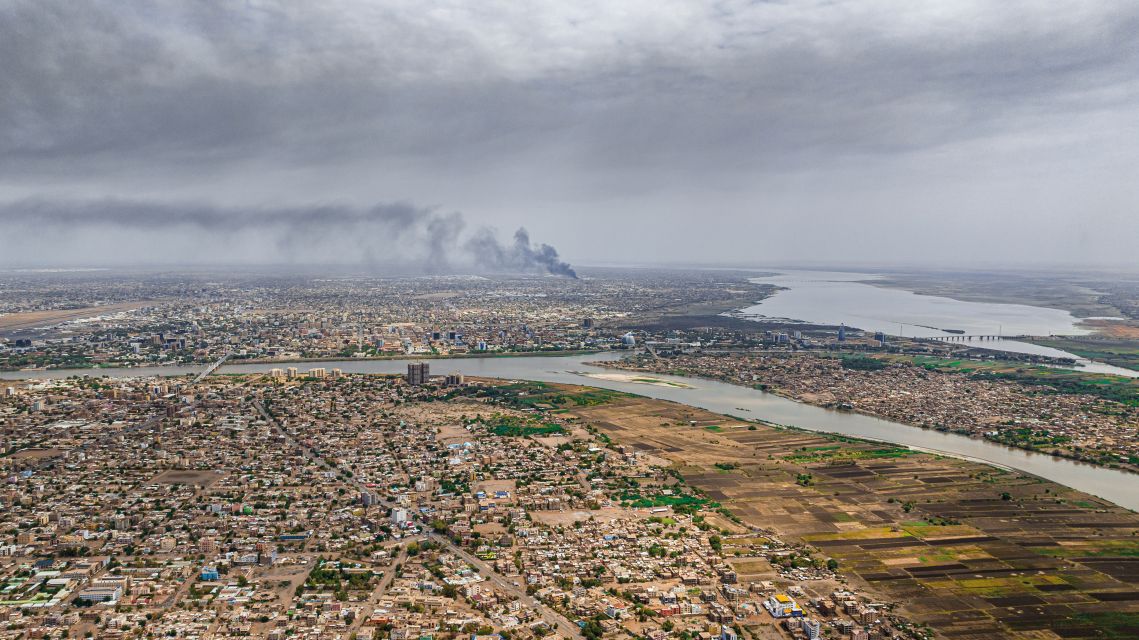
Gazi Nouman describes the sanitation challenges faced in Sudan that have been exacerbated by war.
Khartoum State is often discussed as Sudan’s administrative and economic heart, but it remains poorly understood as a sanitation context, especially after the war. The state’s sanitation profile is shaped by rapid urban growth, a historically limited sewer footprint, heavy dependence on onsite systems, and governance and financing constraints. Since the outbreak of conflict between the Rapid Support Forces and the Sudanese Armed Forces, these structural weaknesses have been pushed into a more dangerous zone: service disruption, infrastructure damage, population displacement and shrinking institutional oversight have combined with major outbreaks of waterborne disease.
This article focuses on what happened to the sanitation context in Khartoum after the war began, why the pre-war sanitation baseline matters and what the public health concerns look like during recovery. It concludes with a brief overview of practical system directions and the potential health gains of context-based sanitation upgrading, which is expressed in Disability Adjusted Life Years (DALYs), a World Health Organization (WHO)recommended metric for disease burden assessment.
Khartoum sanitation sector before the war
Khartoum’s sanitation sector has long been characterised by a gap between population growth and network expansion. Although sewerage exists in parts of Khartoum and Bahry, the system has historically served a limited portion of residents in specific geographical areas, while the vast majority of people relied on onsite sanitation. According to the
WHO/UNICEF Joint Monitoring Programme (2023) the system has experienced limited progress in expanding sewage coverage over the past decade. As a result, septic tanks and pits became the default containment technologies for large portions of the urban population and the city’s sanitation (an unestablished system) functioned less like a service value chain (SVC) and more like a significant number of household-level containments with uneven emptying and disposal practices. This inconsistent desludging is usually undertaken to maintain borehole infiltration and prevent hydraulic failure, rather than to ensure safe sludge management and environmental protection. This matters because sanitation is not only about access to a toilet – it covers the full SVC, from user interface to containment, transport, treatment and safe disposal or reuse. If the chain breaks down at any stage (especially emptying, transport, or treatment) public health risks rise immediately.
Even pre-war, evidence suggested Khartoum faced significant environmental health risks from onsite over reliance combined with weak standards. Groundwater contamination emerged as a core concern. One study on barriers to using groundwater for drinking, identified zones where groundwater was unsuitable for consumption, linking contamination to septic tanks and latrines, including in the Gezira aquifer area within Khartoum State. Another investigation of drinking boreholes found a substantial proportion contaminated with E. coli, with researchers highlighting the lack of environmental criteria in borehole construction and siting. In a city where some households depend on boreholes and where regulatory enforcement has been inconsistent, sanitation quality is not merely an engineering issue, it is a determinant of environmental and public health risk-exposure.
Social settings also showed uneven sanitation quality. For example, a study in Khartoum primary schools reported relatively high latrine availability (with no clear standards) but mixed cleanliness and usage practices, which indicates hygiene and management gaps even in institutional settings. The United Nations Environment Programme has also highlighted that a significant share of schools across the country face sanitation access challenges. These patterns are relevant because conflict tends to expand existing fragilities rather than create entirely new ones.
Service deterioration, displacement and rising health risks
The conflict in Sudan has created one of the world’s most severe displacement crises, with internal displacement exceeding 11.5 million across the country. Khartoum is both a major origin of displacement and a focal point of infrastructure stress. In conflict settings, sanitation systems face multiple simultaneous pressures, including physical damage to facilities, reduced water supply reliability, disrupted emptying services, insecurity limiting movement, loss of staff and institutional control and rapid shifts in population density.
Health consequences have been stark. Sudan experienced severe cholera waves, with reported cases and deaths reflecting how quickly unsafe Water, Sanitation and Hygiene (WASH) conditions translate into national emergencies. These outbreaks are more than simply medical events related to the war, they are indicators of sanitation breakdown, unsafe water access, and weak prevention capacity. In protracted crises, diarrhoeal disease linked to inadequate water and sanitation can kill more children than the violence of conflict itself, especially when health services are disrupted.
The health system’s collapse amplifies sanitation-related risk. Attacks on healthcare, hospital closures and the occupation or non-functionality of facilities have reduced treatment capacity and routine public health functions, with a large share of hospitals in conflict areas reportedly out of service. When treatment capacity shrinks, prevention becomes the primary line of defence, making sanitation interventions more urgent and more cost-effective in human terms.
The war also brought gender-related dynamic hazards around sanitation. Conflict-related gender-based violence and elevated risks for women and girls make safe access to sanitation a safeguarding issue, not only a service gap. In displacement and return contexts, sanitation access affects privacy, mobility and exposure to harm, particularly when facilities are distant, shared or unsafe.
Behavioural repercussions of ‘returnees’
A less visible but critical dimension of Khartoum’s post-war sanitation context is behavioural change linked to displacement. Evidence from other conflict-affected settings shows that when social cohesion and service provision breaks down, open defecation (OD) increases significantly because of displacement. This pattern is already evident within Sudan. In South Kordofan State, 22.2% of surveyed households reported practising OD, while in the Shendi region of the River Nile State, the proportion practising OD reached 44%. Importantly, displacement tracking data indicates that a substantial share of internally displaced populations in these areas originate from Khartoum State. As return movements begin, this creates a tangible risk that OD practices shaped by prolonged displacement and temporary living conditions may be reintroduced into Khartoum neighbourhoods where sanitation services and infrastructure have been degraded or destroyed, rapidly increasing public health and environmental risks if recovery planning does not account for these behavioural dynamics.
In practical terms, post-war Khartoum should expect:
- Higher immediate demand for basic sanitation in areas where households return before services are restored
- Increased risk of OD where containment is damaged, pits are full, or emptying services are absent or not in place
- Heightened environmental contamination risk if rebuilding occurs without standards (especially for pits, septic tanks and boreholes)
- Uneven recovery of sanitation services because of political-economy inequalities, which means that some neighbourhoods will stabilise quickly while others remain exposed to significantly higher health risks
- Cultural requirements that shape sanitation choices.
Khartoum’s sanitation context also includes a crucial design determinant: hygiene practice. Water-based anal cleansing is predominant and is linked to religious requirements for many Sudanese households. With Muslims considered the vast majority in Sudan, sanitation systems that cannot accommodate water use at the user interface are unlikely to be widely accepted. This is not a small detail; it affects toilet selection, water access planning, and how ‘alternatives’ are judged and may be adapted by communities.
In post-war settings, acceptance and consistent use matters as much as technical design. Sanitation technologies that do not align with cultural practice or that require major behaviour change during a period of instability tend to fail or be inconsistently used, reducing health gains even when infrastructure exists.
A sanitation value chain under stress
Khartoum’s sanitation stress points are best understood through the SVC. Pre-war the city already relied heavily on onsite containment, which requires reliable downstream services, such as emptying, transport and treatment. War conditions disrupt these downstream links first.
Potential common breakpoints in post-conflict urban sanitation include:
- Containment failure (damaged pits/septic tanks and poor reconstruction quality)
- Emptying interruption (vacuum trucks unavailable, fuel shortages, insecure access)
- Unsafe disposal (when sludge is dumped informally because of broken treatment links)
- Treatment disruption (plants and pumping stations not functioning, power shortages)
- Governance gaps (unclear authority, weak enforcement, fragmented roles).
This is why post-conflict sanitation recovery cannot focus only on toilets or only on centralised networks. It must rebuild the chain in realistic steps and prioritise interventions that reduce exposure quickly.
What ‘context-fit’ upgrading looks like for Khartoum’s post-conflict era
Given the above context, the most realistic post-war direction is phased upgrading using technologies that work under fragile conditions. In brief, the assessed system direction is:
- Rural/peri-urban: pour-flush toilets with twin pits (or single pits where appropriate), with feasible emptying arrangements
- Urban planned areas: septic tanks (but standardised and better constructed) supported by a robust and well-regulated emptying trucks system in the short term and simplified sewers in the long term, to connect effluent to treatment.
The key is not the ‘perfect technology’, but a package that reduces human-pathogen contact, protects groundwater and can be implemented despite disrupted institutions.
What improved sanitation could deliver
To communicate the health gains in a policy-decision way, I estimated diarrhoeal disease burden attributable to inadequate sanitation using DALYs. Because of limited post-war data, baseline estimates were derived theoretically using two approaches and averaged, producing an estimated sanitation-attributable diarrhoeal burden for Khartoum State of ~33,952.6 DALYs based on pre-conflict sources and exposure relationships.
Using evidence from systematic review and meta-analysis on sanitation interventions, and assuming improved services reach 90% of the population, the intervention modelling suggests approximately 28,020 averted DALYs reported as an ~82.5% reduction in DALYs associated with inadequate sanitation under my assumptions. Although theoretical, this estimate is valuable because it translates sanitation recovery into a public health outcome metric that funders and policymakers can compare across interventions.
A complex picture
Khartoum’s post-war sanitation context is not simply ‘low coverage’. It is a complex profile shaped by a pre-war on-site dominance, groundwater vulnerability, uneven institutional capacity, and now, conflict-driven disruption, displacement, and outbreak risks.
The city’s recovery will depend on making the SVC functional again (especially containment quality, safe emptying, and links to treatment) while designing services that align with cultural practice and safeguarding needs.
Keeping solutions realistic and phased, while measuring progress through public health outcomes, can help shift sanitation from an overlooked sector to a central pillar of recovery. In a context where health services are strained and outbreaks remain possible; sanitation may be one of the highest-leverage investments available.
The author:
Gazi Nouman is a Water, Sanitation and Hygiene (WASH) engineer and Chair of IWA’s Young Water Professionals Sudan Chapter