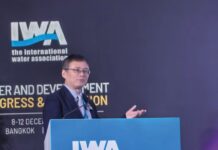

Jorge Rodríguez, Professor and IWA Fellow, considers the ethical obligations for water professionals when water becomes weaponised.
Water sustains life, carries dignity, and can be the boundary between health and despair. Those of us – engineers, scientists and stewards who work with water – often portray ourselves as ‘technical professionals’, separate from the political or humanitarian turbulence of the world around us. Yet, when water is intentionally denied, polluted or used to cause harm, can we still claim neutrality? If our work is to protect life through water, then perhaps ethics should also flow through our profession.
In recent years, the world has witnessed repeated instances of water being deliberately turned into a weapon – treatment plants bombed, pipelines severed and routes blocked to prevent delivery of essential materials. Such acts do not merely damage infrastructure, they dismantle the very systems that sustain civilian life. When the deprivation of clean water becomes systematic – whether through deliberate destruction or through the structural separation of populations, where one group enjoys continuous access to infrastructure, while another lives under chronic restriction – a moral and legal threshold is crossed.
Among the gravest crimes in international law is ‘deliberately inflicting on the group conditions of life calculated to bring about its physical destruction in whole or in part’, as set out in the 1948 Genocide Convention1. International law also condemns institutionalised segregation and domination, as defined in the 1973 Apartheid Convention and the Rome Statute of the International Criminal Court (Article 7)2, 3. For water professionals, these principles converge in a single truth: inequality and deprivation engineered into the flow of water are not technical failures – they are moral ones.
The weaponisation of water confronts us – scientists, engineers and professionals – with an uncomfortable truth. Our field, though rooted in evidence and design, does not exist outside the moral boundaries of humanity. We must reflect on the consequences of silence when our work, or the systems we help build, are used to harm rather than to heal.
Other professions have faced this reckoning before us. Medicine learned how neutrality can become cruelty and forged the codes that now define the duty to treat the wounded regardless of affiliation. Law learned that procedure without conscience legitimises injustice; journalism that objectivity is not indifference but the duty to bear witness. Across these fields, the lesson is the same: professionalism divorced from ethics becomes complicity.
The ethical duty of science reinforces this view. Scientists and engineers cannot dissociate the pursuit of knowledge from its foreseeable consequences. In times of conflict, the principle of moral conscience – the right and duty to refuse participation in acts that cause harm – becomes part of professional integrity. Silence, when knowledge is misused to inflict suffering, is not neutrality, but complicity. For us – scientists, engineers and water professionals – this lesson is especially urgent. Technical neutrality must not become moral indifference. Water infrastructure, such as hospitals, courts or words, can be used to sustain life or to destroy it. The credibility of our field depends not only on precision and data, but also on our capacity to recognise when the principles that govern water are being inverted – when the flow of life is turned into an instrument of harm.
International law already affirms the protection of water. The Geneva Conventions and Additional Protocol I (Article 54) prohibit attacks on objects indispensable to civilian survival, including water installations and supplies4, 5. The United Nations General Assembly Resolution 64/292 (2010) recognises access to safe and clean drinking water as a human right6. Yet laws alone are not enough. Like medicine, our field must transform these legal principles into a living, moral code – to turn international law into professional conscience.
Perhaps it is time for an ‘Ethic of Water Stewardship’, a shared understanding that denying or destroying access to water is incompatible with our calling as scientists, engineers and practitioners. Such an ethic could guide professional associations – including IWA – to reflect on the moral boundaries of our work. This would not politicise our profession – it would anchor it in humanity.
A simple roadmap can start this journey: fostering dialogue, developing shared commitments such as a ‘Water Ethics Charter’, and embedding ethical awareness in how we teach the next generation of water professionals.
The credibility of our community will not be measured only by what we build, but by what we defend. As an international network of scientists and professionals, we can choose to make ethics part of our collective identity – a commitment to protect the right to water wherever it is threatened. Neutrality may keep us comfortable, but conscience keeps us human.
References
United Nations (1948). Convention on the Prevention and Punishment of the Crime of Genocide. General Assembly Resolution 260 A (III), 9 December 1948. United Nations Treaty Series, vol. 78, p. 277.
United Nations (1973). International Convention on the Suppression and Punishment of the Crime of Apartheid. General Assembly Resolution 3068 (XXVIII), 30 November 1973. United Nations Treaty Series, vol. 1015, p. 243.
treaties.un.org/pages/ViewDetails.aspx?src=TREATY&mtdsg_no=IV-7&chapter=4
International Criminal Court (1998). Rome Statute of the International Criminal Court. Adopted 17 July 1998, entered into force 1 July 2002. Articles 7(1)(j) and 7(2)(h).
www.icc-cpi.int/resource-library/documents/rs-eng.pdf
International Committee of the Red Cross (1977). Protocol Additional to the Geneva Conventions of 12 August 1949 (Protocol I). Article 54: Protection of objects indispensable to the survival of the civilian population. ihl-databases.icrc.org/en/ihl-treaties/api-1977/article-54
International Committee of the Red Cross (2005). Customary International Humanitarian Law, Volume I: Rules. Rule 54. Cambridge University Press / ICRC Database.
ihl-databases.icrc.org/en/customary-ihl
www.icrc.org/en/publication/customary-international-humanitarian-law-volume-1-rules
United Nations General Assembly (2010). Resolution 64/292: The human right to water and sanitation. Adopted 28 July 2010. A/RES/64/292. undocs.org/en/A/RES/64/292
The author:
Jorge Rodríguez is Professor of Chemical Engineering, Chair of IWA’s Anaerobic Digestion Specialist Group, and President of the Association of Spanish Scientists in the United Arab Emirates (ACIEAU).